Table of Contents
For a watch nobody has properly seen, the internet seems unusually certain about how it feels. Some think it is genius, yet others are already calling it sacrilege.
Collectors are threatening to sell their watches. Reddit forums are in meltdown. TikTok speculation videos are clocking millions of views. In parts of the UK, people have reportedly begun queuing outside stores days in advance, not for a confirmed product, but for a rumour wrapped in Swiss branding and social media intrigue.
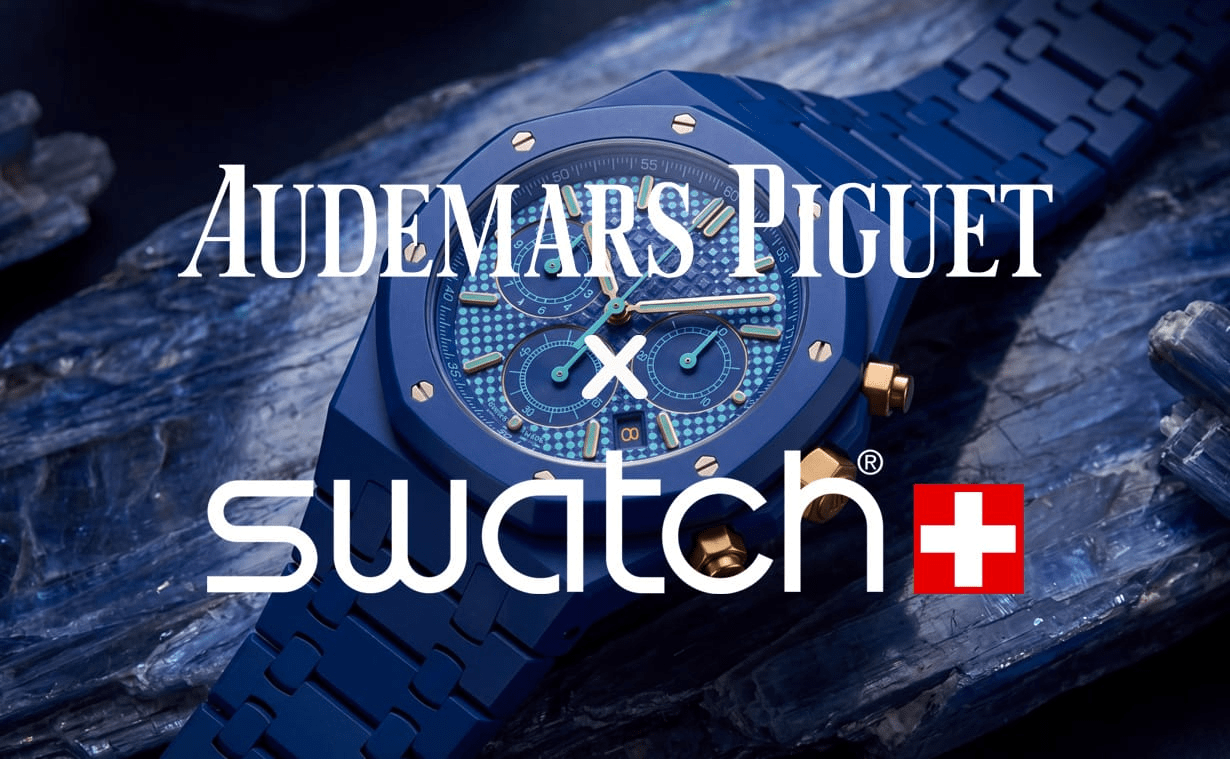
Welcome to Royal Pop: the unexpected, deeply divisive collaboration between Audemars Piguet and Swatch, officially set to launch on 16 May. And before a single official product image has landed, it may already be luxury’s most important conversation of the year.
Because, despite appearances, this is about what luxury means now.
From Untouchable to Obtainable?
To understand why people are spiralling over this collaboration, one must first understand what Audemars Piguet represents.
Founded in 1875 in Le Brassus, Switzerland, AP belongs to a rare category of watchmaking often referred to as The Holy Trinity, a shorthand for the most elite maisons in horology. But more specifically, Audemars Piguet gave the world something that changed modern luxury forever: the Royal Oak. Launched in 1972 and designed by the legendary Gérald Genta, the Royal Oak was radical, an unapologetically industrial steel sports watch that somehow became one of the greatest status symbols in modern culture.
You do not simply walk into a boutique and leave with one. There are waiting lists, relationships, purchase histories, and gatekeeping.
In the UAE, especially, watches sit in an entirely different cultural category. A Royal Oak is social currency. In Dubai and Abu Dhabi, where watches sit beneath rolled-up shirt cuffs in DIFC boardrooms or emerge casually over dinner at members’ clubs, the right timepiece says more than words ever could.
Which is precisely why the idea of a Swatch version has sent shockwaves through the luxury ecosystem. Swatch, colourful, democratic, playful, accessible, is, on paper, the complete opposite of Audemars Piguet, and yet, that contrast is exactly the point.
The MoonSwatch Effect Changed Everything
Luxury purists may hate to admit it, but this story really began in 2022.
When Swatch collaborated with Omega on the now-famous MoonSwatch, many collectors scoffed. How could one of the world’s most respected watchmakers possibly benefit from an inexpensive, playful reinterpretation of the iconic Speedmaster? Then reality happened. Queues wrapped around city blocks, resale prices surged, social media exploded, and, more importantly, younger consumers, many of whom had never considered luxury watches before, knew exactly what an Omega Speedmaster was.
The collaboration became less about affordability and more about aspiration. People who could not yet buy into luxury suddenly wanted in, and luxury, reluctantly, realised something uncomfortable: exclusivity alone was no longer enough, but relevance mattered too.
The Royal Pop appears to be Swatch’s next attempt at recreating that cultural lightning strike, only this time, with a brand even more elusive than Omega. The difference? Audemars Piguet was never part of the Swatch Group to begin with, making this collaboration far more unexpected and loaded.
Why Watch Collectors Are Furious
Luxury consumers rarely fear affordability; they fear dilution. The backlash has been immediate.
Across collector forums and comment sections, some enthusiasts have described the collaboration as “a Ferrari Civic,” a collision between two worlds that were never meant to meet. Others believe AP risks weakening decades of carefully built exclusivity by allowing its most recognisable design language to become accessible to the masses. Emotionally speaking, one can understand why.
When someone spends upwards of AED 100,000 on a watch, sometimes substantially more, part of what they are buying is rarity. The feeling of owning something out of reach. Luxury has always traded in scarcity. The fewer people who can have it, the more powerful it becomes. Which raises an uncomfortable question: What happens when the symbol becomes available to everyone?
If someone at brunch is wearing a playful, bioceramic interpretation of a Royal Oak for a fraction of the price, does the original lose meaning? Or does it become even more desirable? The answer, ironically, may be the latter. History suggests that when luxury becomes culturally louder, desire tends to grow, not disappear. The people buying a Swatch are unlikely to be cross-shopping a six-figure AP. They are buying into the dream, and dreams are powerful business.
Luxury’s New Audience Is Not Waiting Patiently
There is another truth luxury brands are beginning to confront: Gen Z does not aspire quietly. They participate before they can afford. Previous generations admired luxury from afar. Younger consumers engage with it daily, through Instagram, TikTok, fashion week content, celebrity partnerships, and digital culture.
Ownership is no longer the first touchpoint, community and conversation is. Aspiration starts years before acquisition. Luxury houses know this. The smartest brands are no longer only selling products; they are building emotional familiarity. A 24-year-old who buys a playful Swatch today may become a serious collector tomorrow, or maybe not. But they will remember who made them feel included first.
Even ultra-luxury watchmaking, a world traditionally obsessed with patience, heritage, and restraint, understands it cannot remain culturally invisible.
This may explain why Audemars Piguet, long associated with musicians, athletes, and art-world collaborations, seems increasingly comfortable playing within culture rather than merely observing it.
Why the UAE Is Paying Particular Attention
Few places understand aspirational luxury quite like the UAE. Here, watches are identity objects. They sit somewhere between fashion, investment, and status.
A first luxury watch often marks a milestone, a business deal, marriage, promotion, or personal achievement. More seasoned collectors build portfolios as intentionally as they curate wardrobes or real estate. Yet the UAE is also unusually receptive to spectacle, and Royal Pop feels undeniably theatrical.
Even without official imagery, speculation alone has fuelled obsession. Rumours suggest a colourful reinterpretation inspired by Swatch’s 1980s POP line, possibly featuring removable watch elements, wearable accessories, or unconventional styling. Nothing has been fully confirmed, which has only intensified the fascination.
In a region where luxury is often both serious and playful, where collectors wear million-dirham watches to coffee meetings while younger consumers build wish lists through social media, this collaboration feels strangely inevitable, not because everyone will buy it, but because everyone will have an opinion on it.
Genius or Sacrilege?
The most fascinating thing about Royal Pop is that it has already succeeded, and it has not even launched. Whether collectors love it or loathe it, Audemars Piguet and Swatch have achieved something increasingly rare in luxury: genuine cultural conversation. Not a campaign, not an advert, but a moment.
The internet is debating the value of exclusivity, collectors are arguing about status, younger audiences are learning what a Royal Oak is, and luxury traditionalists are being forced to confront an uncomfortable reality: prestige without cultural relevance risks irrelevance altogether.
This collaboration may flop, or it may, and highliy likely, will sell out instantly. Perhaps collectors will eventually laugh about how dramatic they were being. But one thing feels certain: On 16 May, people will be buying into an argument about the future of luxury itself, not just a watch.
Discover more from Private Members AE
Subscribe to get the latest posts sent to your email.